


Position Blueprint starter kit
A one-page framework to define what success looks like—before you hire, onboard, or have another frustrating performance conversation. Includes fillable templates, 12 role-specific examples, and an implementation guide.
With the Position Blueprint Starter Kit,
you'll be able to:
Define success for any role in 30 minutes—outcomes, not vague job descriptions
Stop managing by activity and start managing by results that actually matter
Onboard new hires faster by giving them clarity from day one
Run better performance conversations using the same framework every quarter
Want to understand the framework first? [Read the full guide →]
Clarity that compounds
When people know what winning looks like, they make better decisions, ramp faster, and stay longer. The Position Blueprint creates that clarity in 30 minutes—for any role, at any level.
FAQ’s
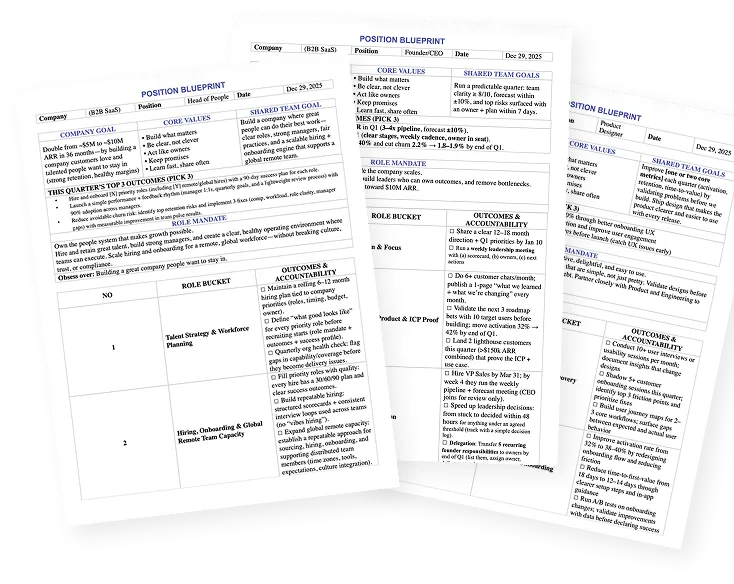
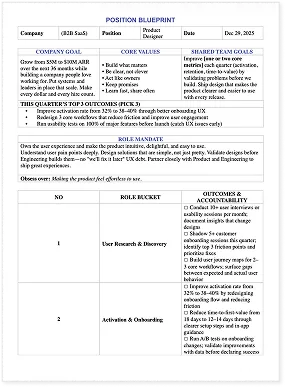
A fillable one-page template you can use immediately, 12 completed examples across common tech and startup roles (engineering, product, design, sales, operations, and more), a step-by-step implementation guide, and best practices for adapting the framework to remote and distributed teams.
The 12 examples span VP of Engineering, Product Manager, Product Designer, Account Executive, Customer Success Manager, Engineering Manager, Staff Engineer, Head of People, Marketing Lead, Operations Manager, Data Analyst, and Founder/CEO. Each shows how to translate the framework to different types of work.
Position Blueprints are inspired by OKRs but simplified for real-world use. Instead of starting with objectives, you start with role buckets—the domains of responsibility someone already owns. Most people find this easier than writing inspiring objectives from scratch. You can layer in OKR-style goals once you're comfortable with the system.
t works for any team, but it's especially valuable for remote and hybrid environments. When you can't see people working, you need a clear definition of success that doesn't depend on proximity. The framework forces that clarity—which benefits every team, regardless of where they sit.
The first draft usually takes about 30–40 minutes.
Here’s the honest part: deciding what actually matters enough to measure takes practice. Most teams don’t get it right on the first pass—and that’s completely normal. Knowing which outcomes signal real success (versus nice-to-have activity) develops over time and improves as the role and business evolve.
Our recommendation is simple: start with your best thinking today and refine as you go. The Position Blueprint is meant to be a living document—something you revisit monthly and sharpen quarterly.
Don’t let the search for perfect metrics slow you down. Writing it down, even imperfectly, forces clarity around what the role is truly accountable for. That clarity compounds over time.
The examples help so you’re not staring at a blank page. But momentum matters more than precision early on. Start with what you know, measure what you can, and let the Blueprint mature as the role does.
Get the Position Blueprint starter kit
Template, 12 role examples, and implementation guide. No cost, no fluff.


