


%20(1).png)
Meeting Alex Ni
At the Divergence Neuro office, Alex Ni didn't just offer me coffee—he taught me how to make it. Pour-over filter, he explained, requires precision: exact bean measurements, a specific grind, water heated to exactly 94 degrees, particular filter paper. It was intricate, unhurried, and worth every minute of waiting. The coffee was exceptional—bright, with an unexpected hint of strawberry.
It also turned out to be a preview of how Alex thinks.
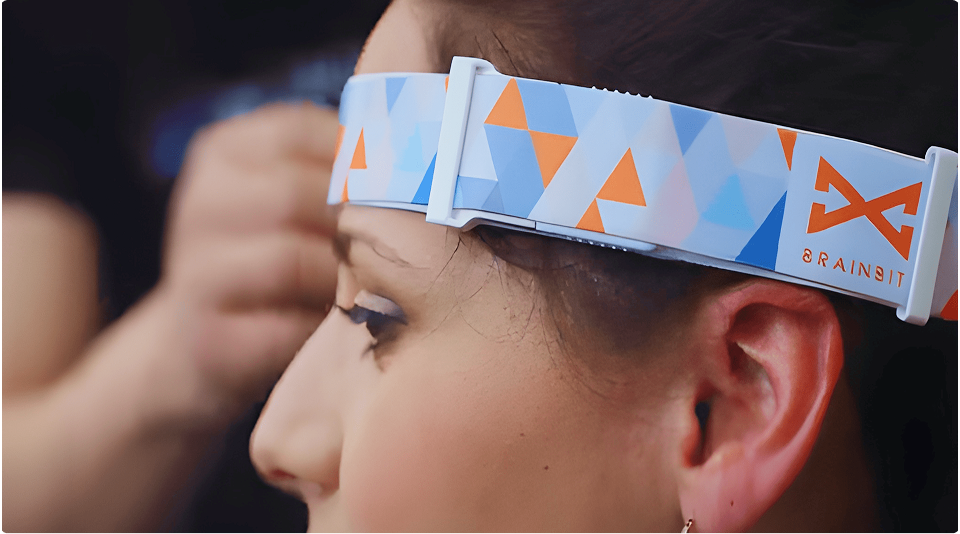
Before we formally started recording, our conversation wandered through territory that felt less like small talk and more like a masterclass. He walked me through the EEG technology Divergence uses—sensors that measure electrical brain activity from the scalp, then use that data to drive real-time neurofeedback. The way I came to understand it in my mind: you can't fix your posture if you don't know you're slouching. EEG gives the brain a mirror for its own activity, and once the brain can see what it's doing, it learns to self-correct. He explained how trauma often gets stored in the body—not just the mind—and why learning to breathe properly can unlock genuine physiological change. He talked about how most people live either in the past or the future, and that regulating the nervous system means learning to stay present. But staying present is hard, he said. We need tools
Then came the detail I'm still turning over: we have two and a half brains. The one in our skulls, yes—but also a smaller autonomous nervous system in the gut. Koilia, he called it, the Greek word for belly. As someone who speaks Greek, I appreciated the etymology. As someone trying to keep up with Alex's thinking, I appreciated the patience.
This is who Alex Ni is: a startup founder, CEO, and neurotech engineer with eighteen years building cloud and AI-driven software, now channeling all of it into making neuroscience accessible for mental health care. Divergence exists because he asked a simple question—how do we use technology to actually help people?—and then built the answer.
What You'll Learn
1. Why specialists are more at risk from AI than generalists
2. The whiteboard trick that reveals if a candidate can actually think
3. Why you can train skills but can't train character—and what to screen for instead
4. The hiring shift that happened in the last five years (and what replaced "years of experience")
5. The one question AI will never answer for you—and why it's now the most valuable skill
6. The question every manager needs to be ready to answer (and most aren't)
7. The four-word morning check Alex uses to protect company culture
The Interview
Tell us about Divergence and how you got here.
Divergence Neurotechnologies is a SaaS B2B software company. We support businesses and service providers in mental health—helping millions of people deal with everything from depression and anxiety to sleeping disorders and PTSD.
Our tools use biometrics collected from the human body—brain waves, heart rate—to develop an in-depth understanding of what's happening in the body and brain. We use modern neuroscience and AI to bring insight to therapists and clients, helping align therapeutic interventions to their actual struggles rather than just labeling them with conditions.
The methodology we support is called biofeedback. Through smartphones, sensors deliver a reliable stream of real-time biometric data. Our software translates that into protocols specific to each client's needs. The brain learns how to recondition itself.
Q: What drew you to this work?
Brain-computer interface has been a passion since I was old enough to read. I pursued engineering and computer science, always interested in systems that process signals and how they can benefit humanity.
When COVID hit, everything changed. I experienced a prolonged depressive period. From being a CTO managing 150 to 200 people, I became someone cooped up in his apartment doing 12-hour Zoom calls about layoffs. That does a number on you.
It made me question a lot. The soul search kept coming back to: how do we use technology to do good? How do we help people in situations like mine?
I'd previously led a small biotech company using mobile EEG and AI to monitor epilepsy. That's where I learned about translating brain waves into something meaningful. The pandemic seemed like the perfect time to come back to that—but instead of just epilepsy, to help a much broader swath of mental health challenges.
Q: How do you approach building a team from scratch?
I started as a developer at Blackberry in 2007, became an architect three years later, then moved through manager, director, VP, and CTO roles. I've managed teams that were already established. What's been different at Divergence is building from nothing. We became cash positive within six months, hired our first full-time employee at eight months. Building block by block, I was the first author of a brand-new culture—a blank canvas. Everything I'd learned from previous positions immediately came back to mind.
I knew what kind of culture I didn't want to build. That excludes a lot of places that are oppressive, top-down, inflexible, authoritative.
We focused on core characteristics of individuals rather than keywords on resumes. You can train for skills, you can adjust aptitude, but what's hard to change is characteristics. This may sound deterministic for a guy whose whole career is about brain plasticity—but it's far easier to train a new skill than to change who someone is as a person.
We've been lucky to hire mostly very curious, mission-driven individuals who really want to make a difference. The fundamental thing I've learned as a founder is that I have to protect the culture of the place and protect a set of principles.
Q: How do you reinforce that culture day to day?
Every morning I wake up and ask myself: do I live these four things that are at the core of our culture?
Curiosity. Am I curious enough to explore new possibilities, to hear this person's point of view?
Openness. Am I open enough to admit I don't know something, that I can be wrong? Can I accept another point of view?
Grit. Do I have what it takes to stick through a problem when things get tough? Do I get stuff out the door, or do I sit there and think that's not my problem?
Agility. Can I adapt when circumstances change?
Every action I conduct as part of this business has to represent one or more of these four things. You have to know what your things are. You have to repeat them. And as a leader, you have to exemplify them. You have to do it yourself.
Q: Walk me through your hiring process.
It starts with understanding motivation. Why do they want to work in this role? We look for things that are unique, that show us a story. What do they care about? What are they curious about? What projects have they done?
If a resume is filled with titles and not what they've actually done, that doesn't stand out. We're suckers for a good story. Why did you get into this? What does that say about what you want to do next?
First interview: we get to know your history, make sure you're a real person we can communicate with. Second interview: more in-depth exploration of technical aptitude. We usually go with a design problem or a real-life case—pick something from your resume and ask questions to see if you really did it.
Q: Are you allowing AI use in interviews?
Developers will probably use AI when they're doing the job, so I don't think it's absolutely forbidden during interviews. But the point is to make sure they know their stuff.
What I do is have a conversation about how to solve the problem. Give them a marker, get them a whiteboard. If their hands are on the whiteboard, they won't be typing on ChatGPT.
My main concern is whether or not you can think. Do you have the logical wherewithal to break a problem into components? Can you question yourself? Those skills can easily be tested without AI.
The thinking part—absolutely no AI. The coding part—you can use AI, but make sure you know what it's doing and make sure you've tested it. Because I'm going to test it.
Q: What's the biggest shift you've seen in the skills engineers need?
Five years ago, we hired by expertise—how much do you know about the things we're looking for. The big shift is that instead of hiring the most senior talent who worked on something for the greatest number of years, we're now looking at adaptability, aptitude, resourcefulness. How do they solve problems they've never encountered before?
AI is best at replacing specialists. What the system is still fairly bad at is coming up with a design and validating it with human actors who don't think like machines. You still need the human giving it the right prompts to have a chance of delivering the right thing.
We're a ways away from true autonomous AGI. Until that happens: how do we safeguard standards? How do we bring more consideration to humans? How do we spend more time with humans to make sure we're building the right stuff for the right people?
Q: What should hiring managers and job seekers do differently?
From the hiring managers' side: instead of years of experience being the only driver that indicates seniority, look at parameters that aren't quantifiable. Look at someone's ability to solve a problem, to understand and ask a question. Years of experience will not be the most helpful piece of information. We have to do the hard work and get underneath the metrics and look at the human behind the numbers. It's not easy, it takes time—but do you want to hire great talent? That takes time.
On the job seekers' side: get very good at understanding problems. This requires every individual to invest their own time to create, to solve problems they've always wanted to solve. AI isn't going to tell you what problems to solve.
As individuals, we have no excuse not to advance our skills and productivity. These tools are increasingly open-source. There are more and more ways to enrich your portfolio.
Q: How do you address AI hesitancy on your team?
I've had conversations with staff who are skeptical. The question gets asked: what's my role as the human in all this if we embrace more and more AI?
Every manager needs to equip themselves to have that conversation. If you care about your culture and you care about delivering, you need the skill to have it. Understand what AI means to your team. What guardrails are you putting in place? Where does the human come in? Have you communicated this to your organization?
We have to learn where our values are, what AI is not replacing. To me, AI will never replace curiosity, grit, openness. It's a tool—but if the human behind it is curious, it can help you do amazing things.
Keep an open mind.


